
/filters:quality(90)/fit-in/970x750/coros-web-faq/upload/images/f4428a08c67481e869e3bdf2e7b5c631.jpeg)
It’s often said that training for the marathon is harder than the race itself, and no one knows this better than top Australian marathoner Izzi Batt-Doyle. A force on the global road running scene, national record holder over the half-marathon distance and running shop owner, Izzi is not one to shy away from hard work.
This makes the Boston Marathon, the oldest and arguably the hardest World Marathon Major, the ideal choice to test herself. Looking to build her marathon strength, Izzi's training approach is structured, deliberate, and consistent by nature.
We took a closer look at her marathon preparation ahead of Boston to understand how strength, consistency, and resilience come together to deliver performance on race day.
Why Boston?
Boston is a bucket list race for many marathoners. The hills and heritage make it one of the most iconic races on the calendar, but with the course not eligible for records, what draws elite athletes here?
"I closed the door on my track career with the 10,000m at World Champs to fully commit to the marathon. You have to put yourself in uncomfortable situations, and Boston felt like the right place to start that next phase. It’s my first major, and I want to learn how to compete in those big races."
Marathon Training
Training for the marathon is different for everyone. Most plans range from 12 to 24 weeks, depending on experience and fitness.
With a strong aerobic base already, Izzi started her marathon-specific training build around 10 weeks out from race day.
"Consistency builds confidence. When I finish a week feeling like I still have a bit more to give, I know I’m in a good spot. You don’t need to go to the well all the time. It’s about the feeling in your body, and the numbers supporting that. You can feel fitness as much as you see it in the data."
Over the following weeks, she gradually increased both volume and intensity, averaging over 180km a week as she approached her peak training phase.
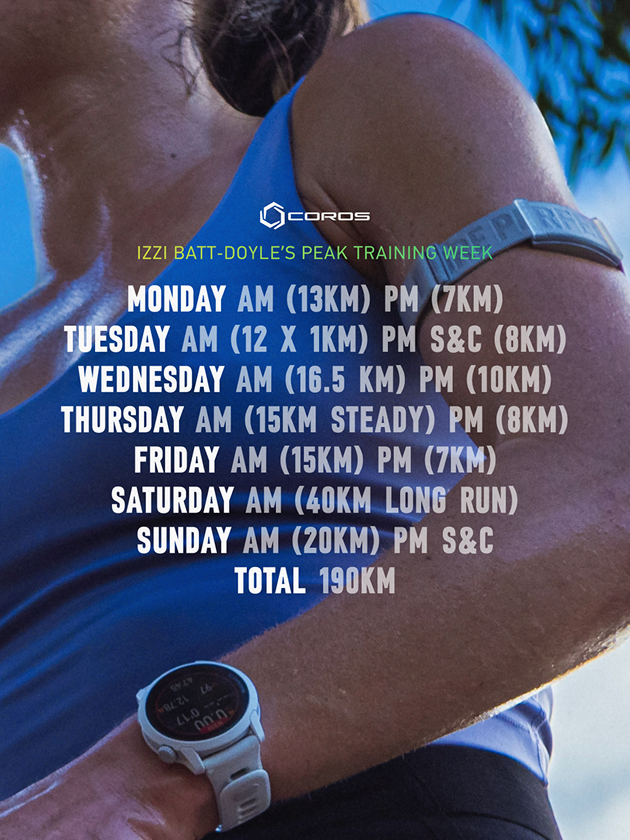
The data behind a peak marathon training week
Recovery Runs
As is often the case in marathon training, the majority of volume comes from easy running. For Izzi, this accounts for around 50% of her weekly mileage, and it is a critical component of her success.
"I’m usually running 60 to 90 seconds slower than race pace on most of my runs. I see a lot of people go too fast on their easy days. Focusing on heart rate during easy runs is just as important as during hard sessions. I’ve made mistakes before where I’ve reached the end of a block completely cooked, so recovery is a big focus for me now."
These runs support:
- Aerobic development
- Recovery between sessions
- Consistency across the week
COROS Education: COROS makes it easy to stay in the right zone. You can set up Activity Alerts directly on your watch to ensure your effort stays aligned with your training goals.
Aerobic Intervals - Marathon Session 1
Workout details;
- Description: 12 × 1km
- Pace: 3:05/km (average)
- Recovery: 60 seconds
- Total volume: 22km
A staple session, this workout sits above marathon pace but below maximal intensity, targeting aerobic power and lactate clearance.
Her heart rate gradually rises throughout the session, moving into the threshold zone, with only partial recovery between reps. As the session progresses, these short recoveries accumulate fatigue, leading to increased time spent at threshold effort.
This session develops:
- Speed endurance
- Efficiency at higher intensities
- The ability to handle pace changes
Heading into Boston, it also prepares Izzi for the surges and hills that define the course.
Boston Specific Hilly Steady Effort - Marathon Session 2
- Description: 15km steady effort on an undulating route
- Pace: 3:41/km
- Effort Pace: 3:37/km
- Total volume: 23km
This session shifts the focus directly to race demands. Boston’s rolling terrain requires effort-based pacing, not split-based pacing.
Izzi executes this with control, her heart rate builds gradually from the low 140s to around 175 bpm, sitting firmly within her threshold zone as the effort increases.
"On sessions like this, I’m not chasing pace, I’m focused on the effort. That's been a bigger focus with this build, I've raced a lot of "fast" marathons, so for Boston focussing on the effort and staying controlled early has left me feeling great longer into sessions"
The key takeaway:
- Consistent effort over variable terrain
- Controlled pacing early
- Strength late in the effort
COROS Education: Effort Pace adjusts your pace based on terrain and personal efficiency, using heart rate to provide a more accurate measure of effort across hills.
Peak Week Long Run - Marathon Session 3
- Description: 4 x 4km during a continuous long run
- Average Pace for entire run: 3:47/km
- Average HR for entire run: 145 bpm
- Total volume: 40km
The long run is the cornerstone of marathon training—and during peak week, it becomes a race simulation. Izzi's marathon long run here involves structured intensity as well as high volume.
Across the session, each 4km block builds in intensity, with pace progressing from 3:28/km down to 3:17/km.
This is developing fatigue resistance and building confidence for the latter stages of the marathon.
Strength Training
Like many elite marathoners, staying healthy is just as important as building fitness. Strength training plays a key role throughout Izzi's training week. Bringing her the benefits of injury prevention, improved running economy and the ability to maintain form under fatigue, all aid Izzi with her training volume and intensity.
"Strength training is usually the first thing to get dropped when things get busy. It’s always been part of my program, but with Boston being such a tough course, I’ve made it a real focus this build."
The Next Step
Like many marathoners, getting to the start line, healthy, fit and ready to race is part of the journey. For Izzi, lining up in Boston represents more than just another race. It marks a progression in her marathon journey.
"Now it’s about becoming the best marathoner I can be. I still feel like I’ve only scratched the surface of what I can do. I want to be competitive in these races, and I believe there are more national records ahead of me, includng going under that 2:20 mark. I’m still learning the marathon, but I feel like I’m moving in the right direction."
By combining structured training, consistent volume, and data-led decision making, she continues to build toward her full potential. Izzi joins the COROS team as a COROS athlete guided by the same COROS products that empower athletes worldwide to achieve their goals.