/filters:quality(90)/fit-in/970x750/coros-web-faq/upload/images/d17ae05bead5f3e1bb87155337612f95.jpg)
Zegama-Aizkorri is one of the few races in trail running where history truly matters. Not just the course record on the board, but the knowledge accumulated across every edition. It pays to know every muddy descent, or the best steep ridge for a surge.
Kilian Jornet has won this race eleven times. He knows the Aizkorri massif the way most people know their commute. And yet, after so much success, he continues to refine his approach in 2026.
To understand where he's going, it helps to look at where he's been — specifically his two most recent editions: 2022 and 2024. Both ended with Kilian on the top step. Of course, no two races are the same, and Kilian's data tells two very different stories about how he got there.
Mastering the Course: Zegama 2022
The 2022 edition marked a new standard for the race. Kilian finished in 3:36:40, taking nearly nine minutes off Stian Angermund-Vik's 2017 course record of 3:45:08. On the surface, it looks dominant. Inside the data, it's a little more precise.
His average heart rate across the race was 164 bpm, peaking at 181 bpm on the early climbs. But what makes 2022 stand out is the competitive fire that fueled it. For over half the race, Kilian and Italian runner Davide Magnini ran side by side, trading the lead back and forth.
At 25 kilometers, the race broke open on a technical descent shortly after Aizkorri. It's a pattern Kilian has shown across many races. On terrain that demands constant micro-decisions, he barely seems to think. He just flows while others pick their way down.
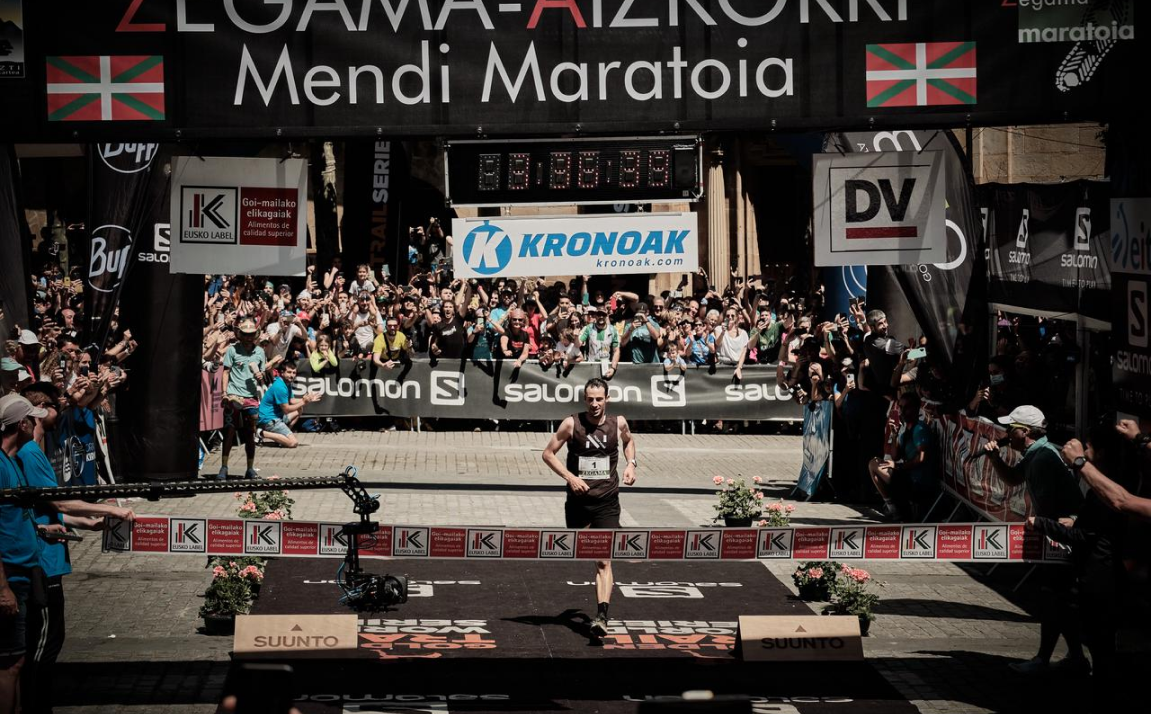
Facing the final major climb of the course, Kilian pushed again to erase any lingering hopes of Mangini coming back. By the time he crested and started descending, the win and course record were his to lose.
The second half of the race averaged 163 bpm, virtually identical to the first. No significant drift. On a course that is mostly uphill for the first half and mostly downhill for the second, that kind of cardiac stability shows that he can produce equal effort on both inclines and declines.
"When I was in my twenties, I just went out and pushed my body as hard as I could, relying on massive training volume," Kilian said of his earlier approach to racing. The 2022 data suggests that era was already behind him. This was a calculated race, run with patience and executed with decisive surges at exactly the right moments.
Mastering Adversity: Zegama 2024
Two years later, under similar conditions, Kilian went back to Zegama with a different objective. He wanted the course record again.
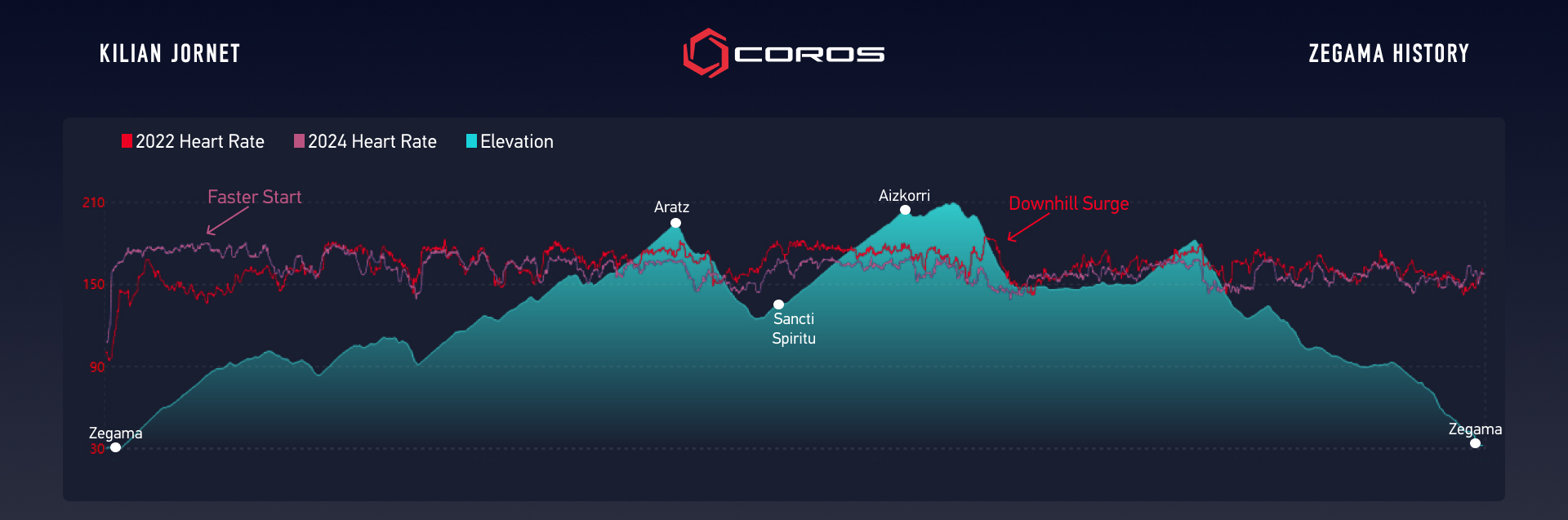
The opening kilometers showed it. Where 2022 had started measured, 2024 started fast. His average HR through the first 10 kilometers was 168 bpm, nearly 12 bpm higher than the same stretch in 2022. Kilometers 2, 3, 4, and 5 all produced heart rates of 172–177 bpm. He was moving.
Through kilometer 21, he was over 2 minutes ahead of his 2022 pace. The course record looked feasible.
Then, somewhere in the final 10 kilometers, his stomach turned.
The data captures the shift clearly. His average HR through the back half dropped to 157 bpm, down from 164 in the first half. In 2022, his HR had held nearly flat across both halves. In 2024, it fell away. Through the same kilometers 33–42 where he had surged to the record two years prior, his HR averaged 155 bpm compared to 160 in 2022. He was managing, not racing.
He still won. His eleventh title at Zegama. He finished in 3:38:07, less than two minutes behind his record. Still the second fastest time ever, despite having absorbed a significant mechanical problem in the final third.
That, too, is a form of mastery.
Two Wins. Two Different Races.
Put the data side by side and a clear contrast emerges.
| 2022 | 2024 | |
| Finish Time | 3:36:40 | 3:38:07 |
| Avg HR | 164 bpm | 161 bpm |
| Effort Pace | 3:52/km | 3:23/km |
| First Half Avg HR | 161.6 bpm | 164.0 bpm |
| Second Half Avg HR | 162.8 bpm | 156.6 bpm |
The most striking number is the effort pace gap compared to heart rate. In 2024, Kilian's effort was higher with a lower average HR. The harder Effort Pace indicates he may not have been as efficient on the climbs as 2022, though. Likely influenced by where his stomach forced him to back off.
Two wins: One defined by a perfectly executed surge, the defined by resilience under adversity. Between them sits a clearer picture of what kind of athlete shows up in Zegama in 2026.
What 2026 Looks Like
The build heading into this year looks different from either previous edition. A result of his refined approach in recent years.
"Now, I focus on training smarter, not harder," Kilian explains. "I pay a lot more attention to recovery and efficiency. What's unique about this year's build is simply the balance: I am managing my training around being a father of three and running my other projects. Because of that, every single training session has a very specific purpose so I don't waste energy."
That purposeful structure extends to the race itself. Kilian has spoken about the role pacing strategy plays in keeping him honest through Zegama's most dangerous stretch: the early, runnable kilometers where the crowd at can pull an athlete well beyond their intended effort.
"Pacing acts as a rational guide to keep my effort steady," he says. "It reminds me to hold back on the easier, runnable sections so I don't burn out my legs before I hit the unpredictable mud and steep climbs."
The 2022 data shows what that kind of control produces on a good day. The 2024 data shows what it costs to push beyond it, even slightly, when the race doesn't cooperate.
"The real race starts when the terrain gets steep heading up to Aizkorri," Kilian has said. "No matter how fresh I feel at the start, I save my energy for those technical climbs and descents."
The data for both races shows this, but 2022 particularly sees a prolonged elevation in heart rate on the climb from Sancti Spiritu to Aizkorri.
He's done it here eleven times. The course record is his. The adversity has been tested. What's left in 2026 is the most complete version of how he races Zegama, built on everything the previous editions taught him.
The Edge Is in the Decisions
Zegama does not always reward the strongest athlete on paper. It rewards the athlete who makes the right decisions, again and again, across a marathon worth of mountain terrain.
In 2022, Kilian made the decisive moves that rewrote the record books. In 2024, he made a hundred smaller decisions in the final 10 kilometers that kept a compromised race from falling apart. Both require the same underlying skill: knowing what the race demands, and responding to it clearly — regardless of what your legs or your stomach or the crowd is telling you to do.
"My advice is to enjoy the energy, but stick strictly to your own pacing plan," he says of Zegama's famously electric atmosphere.
Heading into 2026, Kilian brings eleven wins, a course record, years of hard-earned knowledge, and the humility to keep learning.