/filters:quality(90)/fit-in/970x750/coros-web-faq/upload/images/7ad6ebd065d6b19957d8776f68465b10.png)
A year ago, Eilish McColgan stood on the start line of the London Marathon with a training block that had been compressed by injury. She toed the line of her debut with more questions than answers. She answered most of them. A Scottish record of 2:24:25 was the headline. The experience underneath it was more complicated.
"Last year felt quite up and down," she says. "I'd have a great session and surprise myself, then follow it with a couple of really poor ones."
Consistency is key for running at any level. Doing so is easier said than done, though. The body is difficult to understand, and even a well-planned training block can go sideways for the smallest of reasons. Athletes must become students of their own bodies, fine-tuning everything so they can protect their health and show up day after day ready to work.
Often, the measure of an athlete is dependent on how well and how long they can maintain this consistency. For Eilish, she's doing it better than she has in years.
Watch Used: COROS PACE 4
Accessory: COROS Heart Rate Monitor
Analysis Tool: COROS Training Hub
Speed First, Marathon Second
The decision to spend the opening months of 2026 rebuilding 10km speed rather than going straight into marathon training was deliberate. After knee surgery in 2023, the sharpness that defines McColgan at shorter distances had eroded. Getting it back meant a shorter runway into London, but it was necessary for the long-term. A European 10km record of 30:08 in Valencia in January was the first sign of things to come.
"After my knee surgery in 2023, it became clear that I’d lost a lot of my 10km speed simply because I hadn’t been able to train it properly for so long. So at the start of 2026, that became the main focus. We knew that to run well in the marathon, I needed to get that speed back."
The tighter build hasn't meant a lighter one. Her Training Load through this block has been both higher and more intense than 2025.
"Despite the shorter build, I've actually managed to run higher mileage than last year and, more importantly, I've noticed a big difference in my recovery."
Benchmark on the Treadmill
An unusually warm spring has made outdoor sessions harder to read. Times were slower, making data and fitness comparisons difficult. Then came a treadmill session, and one of the clearest fitness markers of the whole block.
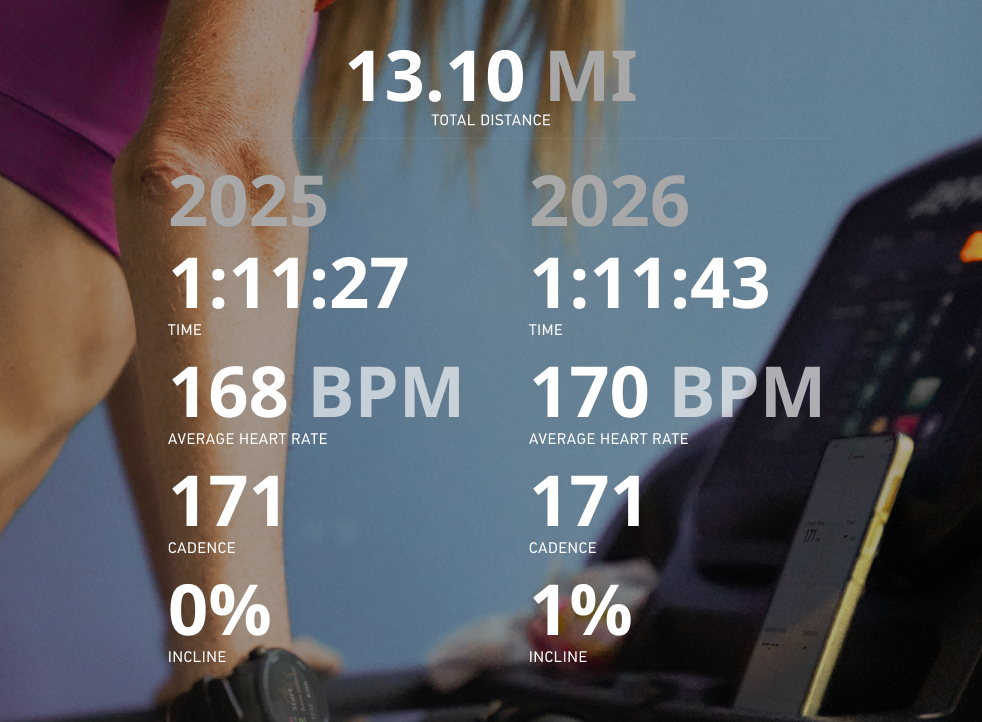
"I jumped on the treadmill and ran 71:40 for a half marathon effort. Last year I was about 20 seconds quicker, but that was on a completely flat treadmill because of my knee issues. This time I ran it at a 1% incline and held the same heart rate, which is a really positive sign. From a data point of view, that's a clear step forward in fitness compared to last year."
Same heart rate. Faster equivalent effort. The numbers look strong.
The Gym, and What Three Years Away Costs
One more addition to this build: the weight room. It's been absent from her training for three years following the knee surgery, and its return is another quiet marker of how complete this preparation feels relative to 2025.
"I've also been able to reintroduce gym work, which I haven't done in three years. I'm hoping that added strength will make a difference as well."
For a marathon runner, late-race strength is often the difference between holding form and losing it. Whether it shows at mile 24 or 25 remains to be seen, but she's going in with more structural durability than she had twelve months ago.
The Number
Ask Eilish McColgan what she's targeting on April 26th and she gives the honest, layered answer of an athlete who has learned to hold ambition carefully.
"The main goal is to run a personal best — as an athlete, you can never be disappointed with that."
Then the other number surfaces.
"Of course, there are bigger goals in the back of my mind, like breaking 2:20. Not many European athletes have done that, so it's something I'd love to be part of."
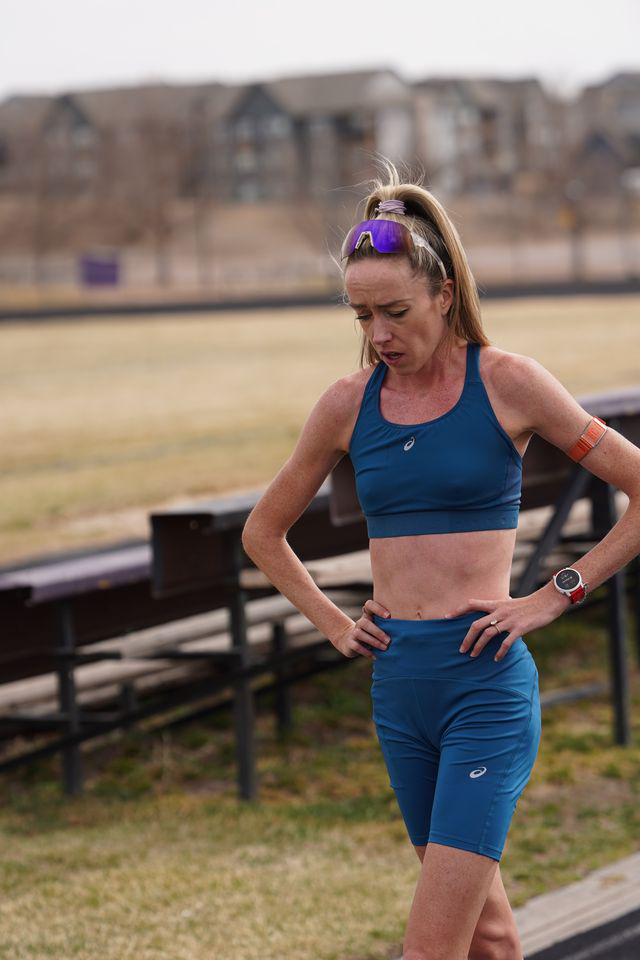
Sub-2:20 would put her in rare company on the European all-time lists. She knows that. She also knows every race comes with its own challenges.
"London is always a challenging race. With it being a women's-only field, it can become quite strung out and lonely. The weather was also tough last year... so I know it won't be easy!"
There's no complaint in that observation, just clarity. She ran most of the race alone last April and still set a Scottish record. This year, she's fitter, more consistent, and stronger. The fitness markers are there. The data backs it up.
If the day is kind, 2:20 might not just be in the back of her mind.